Verdigris • sep - dec 2025 • in BETA
Redesigning product creation so merchandisers launch faster, with fewer errors.
TIMEFRAME
2025 • 1 Quarter
TOOLS
Figma / Claude Code / Lovable
TEAM
Head of Product / Engineering Team / 3 UW graduate researchers
ROLE
0-1 UX Design / Prototyping / Stakeholder Management
What's Verdigris?
An IoT platform that helps data center technicians monitor dense electrical and sensor data across critical infrastructure before they become outages.
What was the problem?
Verdigris was testing a standalone, open-ended chatbot, sitting apart from the dashboard that surfaces anomalies.
Our graduate HCI team was brought in to run usability tests. We discovered it was the wrong interface: it pulled technicians out of their workflow, away from the very data they were asking about.
What was my impact?
Recommended against shipping the standalone chatbot.
Reframed the product from conversational AI to a proactive, alert-first assistant, now in beta.
Defined the ship criteria Verdigris still uses to evaluate AI features.
The Problem
An open-prompt chatbot for technicians who needed to spot faults and act under time pressure, handed the work of identifying the problem straight back to them.
1
Notice a problem
2
Try to ask questions
3
Interpret response
4
Verify the answer
5
Think about next action

Research
We came up with research questions that had pass/fail criteria to run 9 moderated usability tests and 2 contextual inquiries.
The contextual inquiries mattered most. They showed me the environment the chatbot was actually competing with, technicians moving between rooms, checking equipment in person, working under time pressure with a tablet in one hand.
Scannability
Can they understand the answer quickly? Scannable in under 10 seconds, standing at a panel or walking between rooms.
Actionability
Do they know what to do next? Does the answer lead to an operational action, or only describe the problem?
Trust
Can they trust it? Is information they need to act with condifdence present?
Mental Models
Does it fit the real workflow? On tablet, in field conditions, without leaving the task.
Recovery
Can they recover from uncertainty? Verify, escalate, document, or hand off when the AI isn't sure.
how might we
How might we bring AI into the technician's workflow at the moment it is needed, instead of waiting to be asked?
Jobs to be done
We found out that there were 3 core jobs that technicians did and we could assist with them.
1
Triage
"When I'm between buildings, I need to see which ones need attention now so I can respond to the most urgent issue first."
2
Diagnose + Act
"When the AI flags an anomaly, I need to know what's wrong and how serious it is so, I can fix it without interpreting raw data."
3
Hand off
"When my shift ends, I need to pass context to the next technician so they are able to quickly pick up where I left off."
the pivot
I recommended Verdigris not ship the standalone chatbot. To make the pitch, I brought back the scorecard from the usability tests.
criteria for success
usability test results
Understand what to prompt in under 10 seconds
8 of 9 could not scan the response to take any meaningful action
✗
Know what to do next in under 30 seconds
9 of 9 wanted the next step named
✗
Trust the answer
9 of 9 asked where the responses came from
✗
Fit the real workflow
The interface did not fit the tools or environments that technicians were usally in.
✗
Recover from uncertainty
No one even got this far
✗
Solution
In-context AI assistant with actionable recommendations
In-context AI assistant with actionable recommendations
Key Interface Decisions
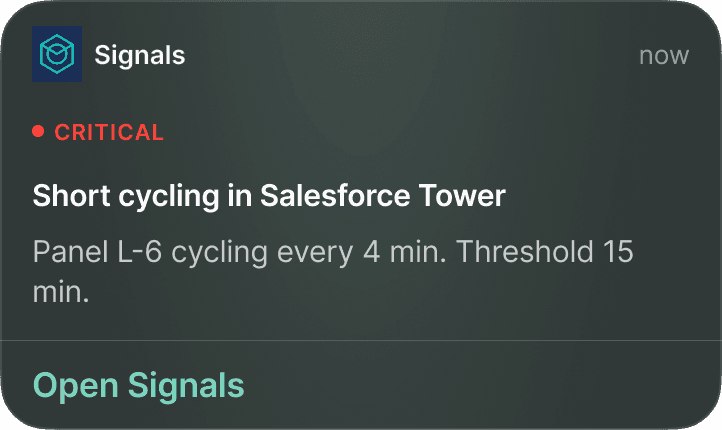
[01] Proactive push notifications based on urgency
User types a question into a chatbot to learn if something is wrong

System alerts when something needs attention
[02] Embedded as a side panel inside the alert
Open ended prompt box
Contextual alert-specific assistant scoped to the active alert
[03] Confidence scores and sources on every diagnosis
Answer with unclear source
Sensor-backed explanation with confidence scores and source attribution
[04] Suggested actions surface alongside diagnosis
Describes what is wrong in aparagraphs
Explains severity and recommends a next step
[04] Arc pre-drafts the handoff note
Technicians figuring out handoff to next shifft
From the alert data + technician's logged findings, Arc writes a first draft. Technicians edit, they don't start from scratch.
iterations
Two directions we ruled out before landing on Arc.
Iteration 1
Standalone mobile app for technicians
Cut because Verdigris didn't want to maintain a separate product alongside the dashboard. It would have fragmented the platform and pulled engineering investment that didn't align with business priorities.

Iteration 2
General chatbot inside the existing dashboard
A floating AI assistant with no alert context. Technicians would still have to re-explain the situation every time. It shifted cognitive load rather than reducing it — and research showed they didn't know what to ask in the first place.

future directions
Accounting for error states and identifying when the human has to take over.
With a 4 month timeline, I could only create a novel MVP to test out with data enter technicians. Identifying error states, human intervention etc,. will need further research and design.
Reflection
The most valuable thing we did was tell the client the problem wasn't the one they hired us to fix.
The brief was a navigation redesign. The data said the real cost was findability and that the fix had to survive on a public agency's budget. Reframing the problem, and designing within a hard no-AI constraint, is what made the solution both usable and sustainable.
↩